

Best moisturizer for all skin type

Moisturizers
There is no single moisturizer that is best for every skin type — but there is a category that comes close, and you can spot it by reading five words.
Aqua, Glycerin, Carbomer, Mineral Oil, Niacinamide, Cetearyl Alcohol, Ceteth-10 Phosphate, Tocopherol, Ethylhexylglycerin, Lavandula Angustifolia (Lavender) Oil.
Ingredients are listed by weight. Mineral oil at position four means this is a rich cream for dry skin — whatever the front of the jar says.
Petals Beauty skincare team · 6 min read
The short answer
A lightweight, fragrance-free gel-cream built on glycerin, niacinamide and hyaluronic acid, with no heavy occlusive oils.
Those three ingredients hydrate oily and dry skin equally well. Everything richer starts to favour one skin type at the expense of another — which is why no single product is genuinely best for everyone.
The label
What “suitable for all skin types” actually means
Nothing, legally. The phrase is unregulated. Any brand can print it on any product, and most do, because it widens the audience at no cost.
In practice it signals one of three things: a genuinely neutral formula that hydrates without doing anything else; a marketing default from a brand that never tested across skin types; or a rich cream wearing an optimistic label.
You can tell them apart in ten seconds. Ingredients are listed in descending order by weight, so the first five make up the bulk of what you are buying. If you see water and glycerin near the top and no oil, butter or fragrance in that group, it is a true all-skin-type formula. If a butter or oil appears in the first five, it is a dry-skin cream.
Aqua, Glycerin, Dimethicone, Niacinamide, Sodium Hyaluronate, Pentylene Glycol, Carbomer, Sodium Hydroxide, Phenoxyethanol, Ethylhexylglycerin, Tocopherol, Disodium EDTA.
Aqua, Glycerin, Carbomer, Mineral Oil, Niacinamide, Cetearyl Alcohol, Ceteth-10 Phosphate, Tocopherol, Ethylhexylglycerin, Lavender Oil.
Label B is our own Glow Enchanting Moisturizer. It is a good cream. It is not a cream for everyone, and we would rather say so here than have you find out after it arrives.
Diagnosis
Find your skin type in four hours
Most people guess wrong, usually because they are reading a temporary state rather than a baseline. Dehydrated oily skin gets mistaken for dry skin constantly. This settles it.
- Wash your face with a gentle cleanser and pat dry.
- Apply nothing at all — no toner, serum, moisturizer or makeup.
- Wait four hours. Stay indoors and do not touch your face.
- Press a tissue to your forehead, nose, cheeks and chin, then check it in good light.
Combination is the most common result. Sensitivity sits on top of the other four rather than replacing them — you can have oily sensitive skin or dry sensitive skin.
Reference
What to buy once you know
| Skin type | Texture | Look for | Avoid |
|---|---|---|---|
| Oily | Gel or gel-cream | Niacinamide, hyaluronic acid, zinc PCA, non-comedogenic | Mineral oil, shea butter, coconut oil, balms |
| Dry | Cream or balm | Glycerin, ceramides, mineral oil, squalane | Alcohol-heavy gels, foaming textures, strong acids |
| Combination | Light lotion or gel-cream | Glycerin, niacinamide, hyaluronic acid | One heavy cream across the whole face |
| Sensitive | Fragrance-free cream | Ceramides, colloidal oatmeal, panthenol, short lists | Essential oils, added fragrance, retinol, acids |
| Acne-prone | Oil-free gel | Niacinamide, hyaluronic acid, non-comedogenic | Occlusive oils, isopropyl myristate, thick balms |
| Normal | Lotion or light cream | Almost anything; a glycerin base is a safe default | Nothing in particular |
Combination skin is where the one-product idea breaks down hardest. The fix is not two moisturizers — it is one lightweight formula everywhere, with a second thin layer on the dry cheeks at night.
Ingredients
The three that work for everyone
Glycerin
Pulls water into the upper layers of skin. Cheap, extremely well studied, non-irritating, and effective across every skin type. In low humidity — a Pakistani winter, an air-conditioned office — it outperforms hyaluronic acid, because it draws moisture more reliably when there is less of it around. Glycerin second or third on a list means the product is doing real work.
Niacinamide
The closest thing skincare has to a universal ingredient. It strengthens the barrier, regulates oil, reduces the look of pores and gradually evens dark spots. Oily skin gets the oil control; dry skin gets the barrier support. Useful concentrations sit between 2% and 5% — above 10% it starts causing flushing in sensitive skin without adding benefit.
Hyaluronic acid
A humectant that holds many times its weight in water — weightless enough for oily skin, hydrating enough to layer under a cream for dry skin. One caveat product pages rarely mention: in very dry air it can draw moisture out of your skin if you do not seal it. Apply to damp skin, then follow with a moisturizer.
And two that do not suit everyone
Heavy occlusives — mineral oil, petrolatum, shea butter, coconut oil — are excellent for dry skin and genuinely too heavy for oily skin. Fragrance and essential oils, lavender and citrus included, are among the most common causes of irritation in skincare. A product containing either can be a very good moisturizer. It just cannot honestly be sold as suitable for all skin types.
From Petals Beauty
What we would actually sell you
We would rather point you to the right product than the nearest one.
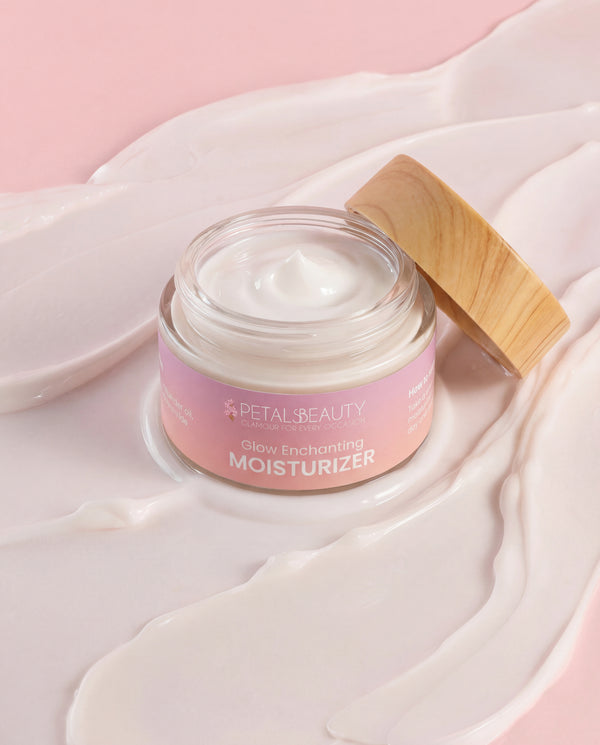
Glow Enchanting Moisturizer
A rich cream built on glycerin for hydration, mineral oil to seal it in, and niacinamide for barrier support and gradual brightening. It works on the face and the body — particularly on elbows, knees, hands and heels, which stay dry year-round.
Not for oily or acne-prone skin. It is a rich occlusive cream and you will find it heavy. A gel will serve you better.
Contains lavender essential oil. Patch test on your inner forearm and wait 24 hours if your skin is fragrance-reactive.
Method
How to apply it properly
- Cleanse, then leave skin slightly damp. Pat almost dry rather than completely dry. This is the step most people get wrong — moisturizer works partly by sealing existing moisture in, and there is far less to trap on bone-dry skin.
- Use a pea-sized amount for the face. More is not better. Excess sits on the surface and pills under makeup.
- Massage upward and outward until it disappears. Include the neck.
- Wait three to five minutes before sunscreen, primer or foundation. Applying makeup over unabsorbed moisturizer is the usual cause of pilling.
- Repeat morning and night. Lighter in the morning under sun protection, richer at night.
Roman Urdu: Chehra dho kar halka geela rehne dein, phir mattar ke daane jitni cream laga kar upar ki taraf massage karein. Bilkul sukhi skin par lagane se faida kam hota hai.
Corrections
Five things that make a good moisturizer fail
Questions
Frequently asked
Which moisturizer is best for all skin types?
A lightweight, fragrance-free gel-cream containing glycerin, niacinamide and hyaluronic acid, with no heavy occlusive oils. That combination hydrates oily and dry skin equally well without clogging pores or irritating sensitive skin. Anything richer favours dry skin; anything with added fragrance risks irritating sensitive skin.
Can one moisturizer really work for everybody in a household?
For most people, yes — a neutral gel-cream will keep normal, combination and mildly oily skin comfortable. It will not be enough for genuinely dry skin in winter, and anyone with eczema, rosacea or a fragrance allergy needs a formula chosen for that condition. As a shared everyday product it works; as a solution to a specific skin problem it does not.
What is the difference between a moisturizing cream and a lotion?
A cream contains more oil and is thicker, so it holds moisture in for longer — the better choice for dry skin and for winter. A lotion is lighter and absorbs faster, which suits normal and combination skin, especially in summer. If your skin feels tight a few hours after a lotion, a cream is what you were missing.
My skin is oily and breaks out. What should I use?
An oil-free gel labelled non-comedogenic, ideally with niacinamide to help regulate oil and reduce the look of pores. Avoid mineral oil, coconut oil and shea butter in the first five ingredients. Do not skip moisturizer altogether — that reliably makes oiliness worse.
My skin feels tight and dry, especially in winter. What should I use?
A richer cream or balm that both draws water in and seals it there — glycerin plus an occlusive such as mineral oil or squalane, applied to damp skin. In Lahore and Islamabad winters, lightweight lotions that felt fine in summer often stop being enough by November.
I have sensitive skin. What should I look for?
A fragrance-free formula with a short ingredient list. Colloidal oatmeal, panthenol and ceramides help; essential oils and added perfume are among the most common triggers. Patch test on your inner forearm and wait 24 hours before applying anything new to your face.
Should I choose by skin type or by season?
Both, in that order. Skin type sets the texture range you should shop within; season moves you up or down inside it. Someone with combination skin might use a gel in summer and a light cream in winter — but never a heavy balm, at any time of year.
Do I need a separate cream for my neck?
No. The skin on your neck is thinner and shows ageing earlier, which is a good reason to extend your face moisturizer down to it — not a reason to buy a second product. A dedicated neck cream is optional.
How often should I moisturize?
Twice daily, morning and night. In the morning, follow with sun protection as the final step. At night, a richer texture supports the skin's overnight repair.
Where does moisturizer go in a skincare routine?
Thinnest to thickest: cleanser, then toner, then serum, then moisturizer. Moisturizer is the last skincare step, sealing everything beneath it — with sunscreen applied on top of it in the morning.
What is the best moisturizer for all skin types in Pakistan?
A lightweight glycerin- and niacinamide-based formula bought locally, so you can replace it easily and avoid counterfeit imports. Pakistan's climate makes the seasonal split unusually sharp: a gel or light lotion from April through September, a richer cream from November through February. Two moderately priced products for the two seasons works better than one expensive cream year-round.
How long before a new moisturizer shows results?
Hydration is immediate — skin feels softer the same day. Barrier repair takes roughly four weeks. Brightening from niacinamide takes eight to twelve weeks of consistent use. If a product is going to irritate you, you will know within a week.
Leave a comment